
Anyone who has ever worked to some degree with electronics – whether putting together a simple timer, designing filters for audio equipment, or troubleshooting circuits, to cite just some possibilities – is likely to have encountered RC circuits.
This type of electric circuit sees widespread use in everyday technology, including for such applications as power supplies, filters, oscillators, and signal processing.
However, there might be many things you don’t yet know about the functionality of RC circuits. So, in this guide for hobbyists, students, and engineers, we’ll set out such circuits’ behaviour, the importance of the time constant, and some other practical aspects you should know about.
An Introduction to RC Circuits and Their Components
The initialism “RC” in “RC circuit” refers to “resistor-capacitor”. An RC circuit can therefore be defined as an electric circuit in which a resistor (R) and a capacitor (C) are connected together.
An RC circuit functions by managing the flow and storage of electrical energy. Its key components and behaviour can be described as follows:
- The resistor limits the flow of current, slowing down the charging or discharging process. It effectively acts, then, as a gatekeeper, restricting the amount of current that can flow at any given time.
- The capacitor stores electrical energy in an electric field. This component’s behaviour as a temporary storage tank for electrical charge leads many people to liken it to a tiny battery; indeed, it both charges and discharges.
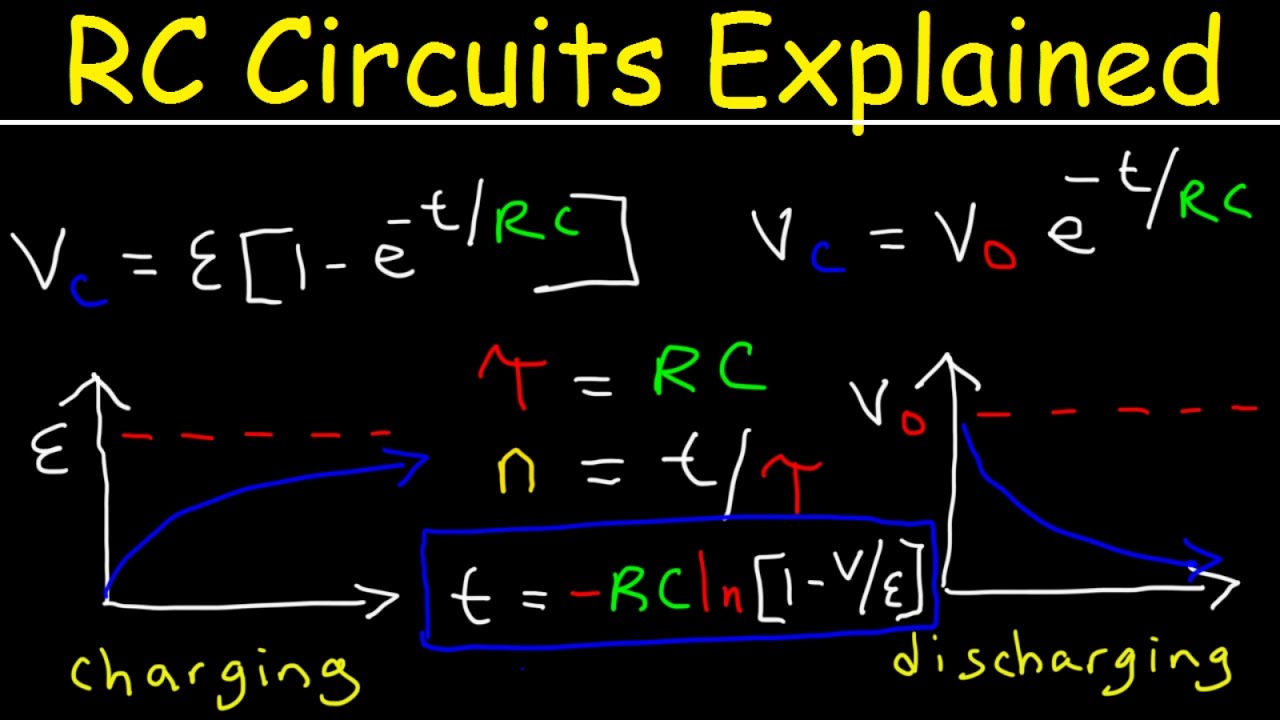
- The charging stage involves current flowing from the source, through the resistor, and charging the capacitor until it reaches maximum charge (steady state).
- The removal of the source causes the discharging process to occur. The capacitor discharges its stored energy through the resistor, with current going down over time.
What Is the Time Constant?
If you’re interested in knowing how quickly a given system responds to a change, you need to familiarise yourself with the concept of the time constant. The “speed” of an RC circuit is defined by its time constant, which is denoted by the Greek letter, tau (τ).
Anyone wishing to calculate the time constant needs to apply the following super-simple formula: τ = R x C, where R is resistance measured in ohms (Ω), C is capacitance measured in farads (F), and τ is the time constant measured in seconds (s).
It is important to understand that the time constant is not the time it takes for a capacitor to reach 100% charge. Instead, it adheres to this “rule of thumb”:
- One time constant (1τ) is when the capacitor reaches approximately 63.2% of its final voltage when charging, or drops to 36.8% of its initial voltage when discharging.
- For most practical engineering applications, it is after five time constants (5τ) that a capacitor is considered “fully” charged or discharged. This is equivalent to it reaching roughly 99.3%.
The Importance of The Time Constant In ‘Real-World’ Contexts
A strong understanding of the time constant will help you with various projects that you might take on as a hobbyist, student, or professional engineer, such as:
- Timing circuits
- Debounce circuits for buttons and switches
- Low-pass/high-pass filters for audio or sensors
- Power-on reset circuits in microcontroller projects
Well-chosen online tools – such as the RC time constant calculator on the website of electrical component store, RS – will further help you get the best out of applications like those cited above.
Yes, it is an easy process to manually calculate τ. However, online calculators can be useful if you want to experiment with different values or include energy stored in the capacitor.
Mastery Of the Time Constant Can Profoundly Benefit Your RC Circuit Projects
RC circuits are no less than one of the most fundamental and useful topics in electronics. Hopefully, whether you’re presently studying for exams or perhaps prototyping onto a breadboard, this article will have given you important insights that you can proceed to apply to a broad range of real-world applications.
Knowing about the time constant very much feeds into this. Experimentation is great, but it is even greater when backed up with an understanding of this crucial aspect of RC circuits.
